Why Successful AI Pilots Still Fail to Deliver Enterprise Value

8 mins read

October 28, 2026



Have you noticed how the conversation around AI has changed?
A year ago, AI was about experimentation. Today, the conversation has shifted to building production-grade AI workflows that deliver measurable business value at scale.
Every enterprise has AI ideas. Many have launched pilots. Yet, only one-third of organisations have successfully scaled AI to transform their core business operations.
So what changed?
The problem was never proving that AI could work. The problem is turning a successful pilot into an organisational capability that delivers measurable business value. That's where most organisations get stuck.
So, what practical steps can you take in 2026 to change the conversation and build a different impact? In this guide, we'll explore the common execution gaps that prevent long-term success and a roadmap to build ROI from your own AI use cases!
“The Missing Middle” Between an AI Pilot and Enterprise Scale
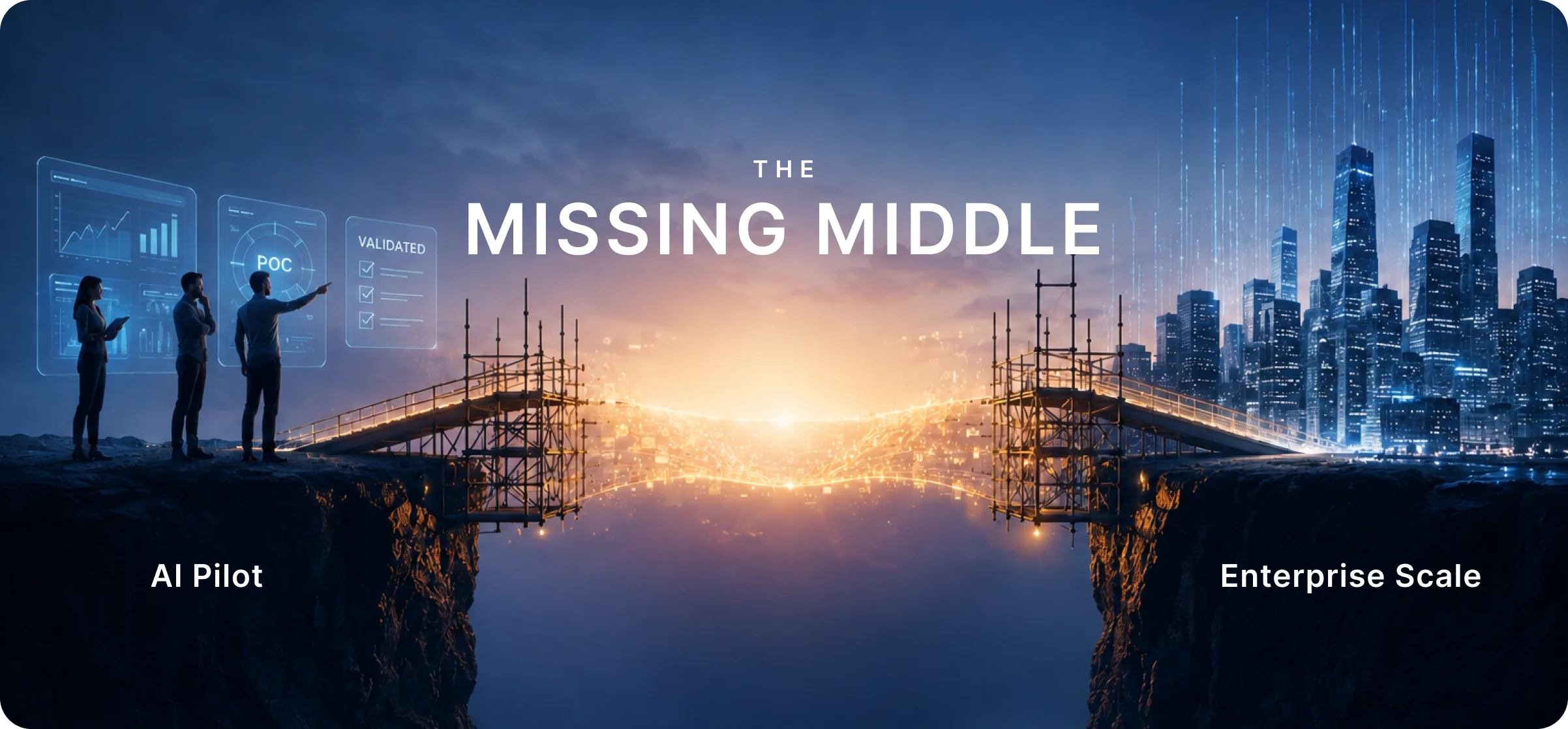
Most AI initiatives successfully complete three milestones. They identify a promising use case, build a proof of concept, and validate that the technology works. At this stage, many organisations assume the next step is simply to roll AI out across the business.
However, between validating AI and embedding it into everyday business operations lies what we call The Missing Middle. It's a series of execution decisions that every organisation must navigate before AI can become part of everyday operations.
Research consistently points to challenges such as poor data quality, fragmented infrastructure, governance, change management, and unclear ROI. While these barriers are real, they are symptoms, not the underlying problem.
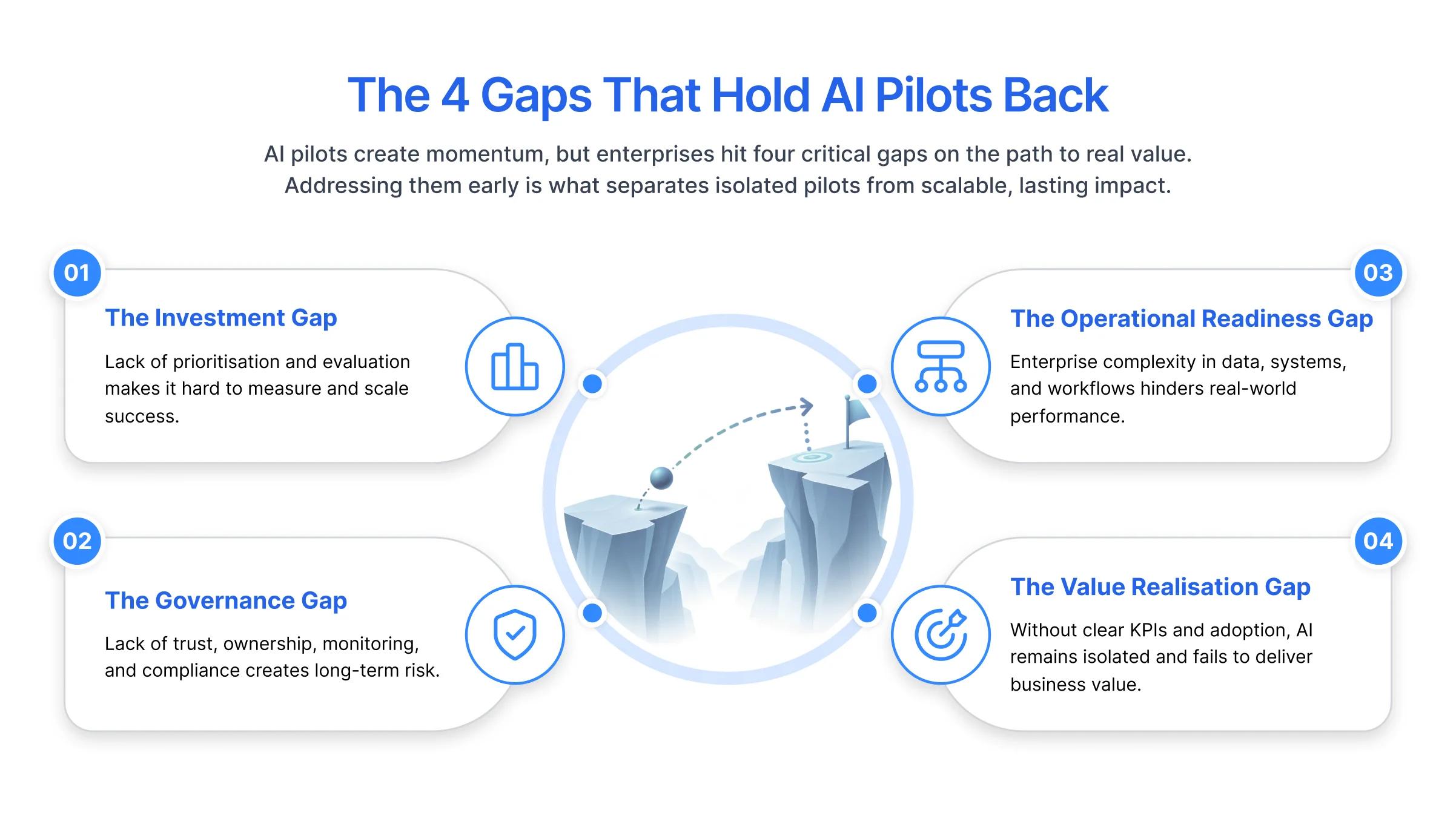
When we look across successful enterprise AI transformations, these challenges typically fall into four execution gaps, as follows:
🔍
1. The Investment Gap
Every business unit can identify repetitive tasks, manual processes, or customer pain points that could potentially benefit from AI. As enthusiasm grows, multiple pilots are launched across different teams, each solving a local problem with its own objectives, technology stack, and success metrics. And slowly, success becomes difficult to measure.
Leading organisations take a different approach. Before building anything, they evaluate each opportunity against questions such as:
- Does this solve a high-value business problem?
- Is the required enterprise data available and reliable?
- Is the initiative scalable across multiple teams or business units?
2. The Operational Readiness Gap
During a pilot, AI typically operates with a limited number of users, carefully selected datasets, temporary integrations, and clearly defined workflows. Enterprise environments look very different.
AI must work with live organisational data, integrate with existing business applications, support operational workflows, and perform consistently across multiple teams.
In practice, organisations often discover challenges such as:
- Business data spread across ERP, CRM, and legacy systems.
- Manual workflows that interrupt AI-driven processes.
- Limited integration between enterprise applications.
- Infrastructure designed for traditional software, but not AI workloads.
3. The Governance Gap
During a pilot, the primary question is usually: Does the AI work?
During enterprise deployment, the very same questions change to
- Can the output be trusted?
- Who owns the model?
- How are decisions monitored?
- What happens if the model produces an incorrect recommendation?
- How is sensitive business information protected?
Many organisations introduce governance only after a pilot demonstrates success. Unfortunately, that's also the moment when governance becomes significantly more complex.
We have seen this challenge firsthand.
A state transportation agency couldn't trust AI-generated permit recommendations without clear explanations. Techolution's AI-powered Permit Advantage validated every recommendation against the MUTCD and provided supporting reasoning. The result: permit review time fell from 30 days to just 3 days, giving engineers the confidence to use AI in production.
4. The Value Realisation Gap
Perhaps the biggest misconception in enterprise AI is that a successful pilot guarantees business value. In reality, a pilot can only demonstrate that AI can perform a task.
Enterprise AI succeeds only when that capability consistently improves business performance.
Executives evaluate whether AI produces outcomes such as:
- Lower operating costs
- Faster decision-making
- Higher workforce productivity
- Better customer experiences
- Increased revenue or profitability
So without clear KPIs, user adoption, and continuous measurement, AI remains an isolated capability rather than an enterprise advantage. Teams return to existing ways of working, investment slows, and scaling loses momentum.
Closing the Execution Gaps
Before building another pilot, organisations need confidence that they're investing in the right opportunity.
Start with AI Value Finder (the first stage of the BPA 4.0 System)
AI Value Finder helps business and technology leaders evaluate AI initiatives based on business value, process maturity, data readiness, implementation complexity, and expected ROI.
While working with Techolution, organisations leave with a prioritised roadmap of the AI opportunities most likely to deliver measurable business impact.
Turn Prioritised Opportunities Into AI-Powered Workflows
Once you’ve identified the right opportunities, the next step is putting AI to work.
FEA solutions help organisations integrate AI into existing workflows and systems. They support explainable recommendations and help teams review the information behind decisions. Organisations can then measure outcomes and expand successful use cases.

Blog Summary
Execution Gap
How Techolution Helps
Investment Gap
AI Value Finder identifies, prioritises, and builds a roadmap for the AI initiatives with the strongest business case.
Operational Readiness Gap
FEA solutions integrate AI into workflows using existing systems and data.
Governance Gap
It delivers explainable, trustworthy AI with enterprise-grade governance and security controls.
Value Realisation Gap
This also helps organisations measure business outcomes, demonstrate ROI, and confidently scale successful AI initiatives.
Worth a read? Pass it on