Why AI Doesn't Scale Like Software (and What to Do About It)

8 mins read

October 26, 2026



AI can help employees write code, analyze information and complete tasks faster. But faster work does not always lead to better business results.
Unlike traditional enterprise software, AI adoption often begins with individual employees and teams experimenting with tools. Teams may improve their own work without improving the larger processes they share with other departments.
To scale AI successfully, businesses need to connect these individual improvements to the goals and processes that drive overall performance.
Why AI Scales Differently From Traditional Software
Traditional enterprise software, such as enterprise resource planning (ERP) and customer relationship management (CRM) systems, are usually introduced through planned implementations.
Organizations integrate the software with existing processes and establish how employees will use it.
AI adoption often starts before these decisions are made. Employees can begin using AI tools independently, creating new ways of working before the organization has agreed on shared priorities and standards.
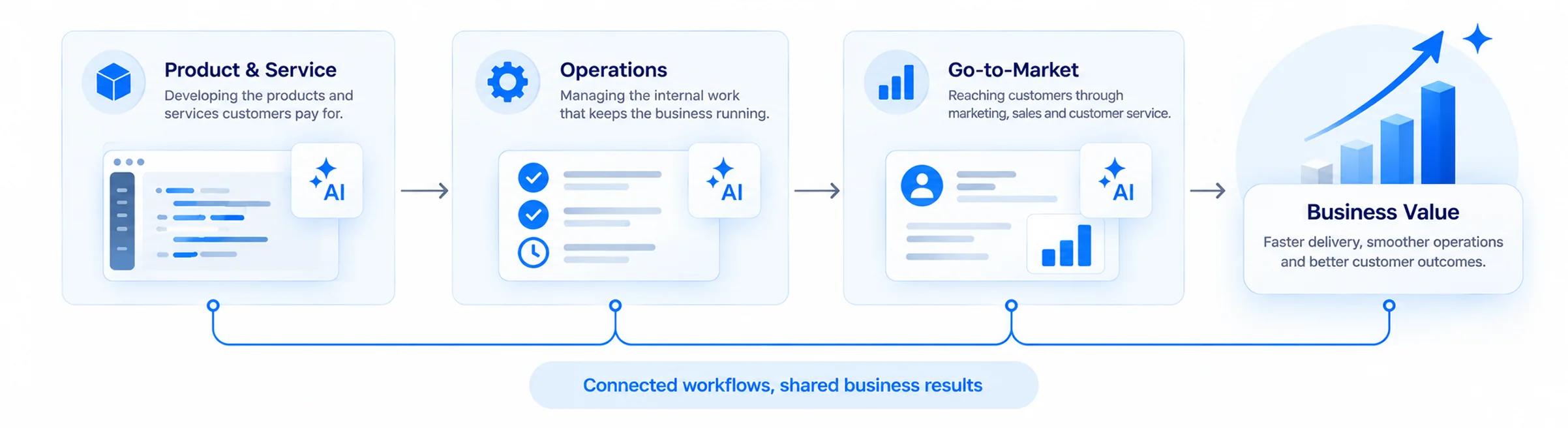
Consider three core business functions:
- Product and service: Developing the products and services customers pay for.
- Operations: Managing the internal work that keeps the business running.
- Go-to-market: Reaching customers through marketing, sales and customer service.
🔍
These functions depend on one another. AI might help a sales team respond to customers faster, but that improvement has limited value if operations cannot fulfil demand.
Similarly, generating code faster does not necessarily mean a product reaches customers sooner if testing and approvals remain slow.
The challenge is connecting improvements across teams so they contribute to the same business goals.
When AI Usage Doesn't Translate Into Value
Recent examples show why measuring AI activity alone can be misleading.
Uber reportedly exhausted its annual budget for AI coding tools within the first few months of 2026. In an interview with The Information, Uber's CTO discussed how quickly spending had grown as engineers adopted tools such as Claude Code. source
Amazon also discontinued an internal AI leaderboard after employees reportedly inflated their scores through unnecessary tasks. source
Both examples highlight the same problem: measuring AI usage alone does not show whether the business is benefiting.
Leaders need to measure what matters, from cost savings and fewer errors to faster service and better customer outcomes. AI governance helps establish the priorities, cost controls and accountability needed to turn AI usage into measurable business value.
Four Governance Pillars for Scaling AI
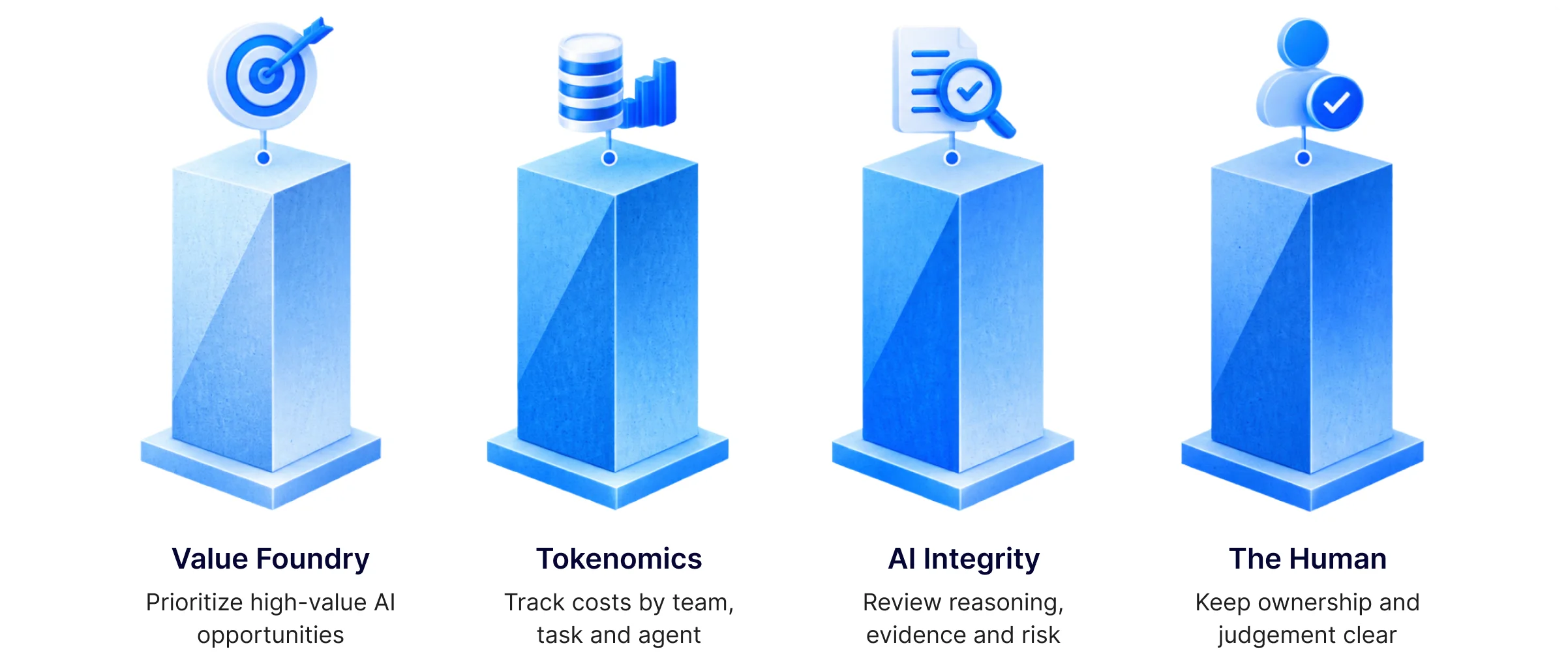
At Techolution, we approach these challenges through four AI governance pillars: Value Foundry, Tokenomics, AI Integrity and The Human. Each addresses a key part of scaling AI across the enterprise, from choosing the right opportunities and managing costs to reviewing AI decisions and keeping people accountable.
🔍
1. Value Foundry: Choose the Right Opportunities
Not every task needs AI, and not every AI idea deserves investment. Leaders need to identify opportunities across teams and prioritize those with the strongest potential business value.
Each initiative should have a clear objective, such as reducing processing time, improving quality or lowering costs. This helps organizations decide where to invest first.
2. Tokenomics: Understand What AI Costs
A single monthly bill can hide where AI spending is going. Leaders need visibility into costs by team, task and AI agent to understand which uses justify the expense.
Budgets, spending alerts and waste detection can help organizations identify unnecessary usage and keep costs under control.
3. AI Integrity: Make Decisions Easier to Review
AI can produce an answer confidently and still be wrong. For important business decisions, teams need to understand why an answer was given, identify potential risks and know when further review is necessary.
Decision records, confidence indicators and traceable changes to rules can help people examine AI outputs rather than relying on an answer simply because it sounds convincing.
4. The Human: Keep People Accountable
Giving employees access to AI tools is only the beginning. They need to know which tools are approved, how to use them and when human judgement is required.
Every AI agent should also have a clear owner who is responsible for monitoring its performance and addressing problems.
How AI Governance Helps Businesses Scale
AI governance turns these priorities into a consistent way of managing AI across the enterprise. It defines how AI initiatives are approved, how costs are monitored, how important decisions are reviewed and who is accountable when something goes wrong.
The level of oversight should depend on the work involved.
An AI tool summarising documents may need basic checks, while one processing insurance claims or influencing financial decisions may require stricter controls and human review.
The aim is to make these checks part of everyday AI operations, rather than handling them separately for every team. This helps organizations manage risks and costs while giving employees clear boundaries for using AI.
AI governance is not just about controlling AI. It helps businesses expand its use with clear responsibilities and better visibility into performance.
From AI Adoption to Enterprise Results
AI can spread across an enterprise faster than traditional software implementations. Turning that adoption into business results requires clear priorities, cost visibility, reliable decision-making and accountable ownership.
AI governance brings these responsibilities together, helping organizations manage AI as its use grows.
Explore Techolution’s AI Governance Hub to learn how enterprises can govern AI agents, manage access, and maintain accountability as AI adoption grows.
Ready to strengthen your AI governance?

Worth a read? Pass it on