Why Successful AI Pilots Still Fail to Deliver Enterprise Value
Your next AI challenge isn't building another pilot. It's turning one successful pilot into enterprise-wide ROI. Most organisations never make that transition. Here's how to avoid becoming one of them.



AI + Circular Economy = The Future of Sustainable Business
Discover how AI-driven solutions are transforming waste management, supply chains, and sustainability efforts. Ready to future-proof your business?
ut what once served as the backbone of business has now become a growing liability.
The Critical Flaws Lurking Beneath Your Legacy Infrastructure
The vulnerabilities in legacy code are not theoretical—they are repeatable patterns attackers know better than your own team.
Modern attackers don’t need to innovate. They just need to exploit wh
1. Obsolete Libraries with Active CVEs
Most enterprise apps rely on hundreds of third-party libraries. But in older systems, 70% of these contain known, unpatched vulnerabilities.
Common offenders include: Log4j (v2.16), Jackson (<2.9), and Apache
You might have:
- Different permissions in staging vs. production
- Overly permissive IAM roles or exposed firewall ports
- Disabled logging due to past performance issues
- Legacy cron jobs still running with elevated permissions
These gaps rarely raise red flags in traditional vulnerability scans; however, attackers spot them with ease.
The Cost of Inaction?
Enterprises often burn 60–80% of IT budgets just to keep legacy systems afloat. Patches are delayed to avoid downtime, while technical debt piles up like interest.
The result? A high-risk loop where vulnerabilities outpace fixes, modernization stalls and security quietly erodes.
Considering the consequences, AI-powered solutions step in—seeing what humans miss and adapting faster than threats evolve.
How AI-Powered Code Analysis
Smarter Vulnerability Detection From Pilot to Production
AI tools can enhance precision across every phase of the software lifecycle — especially where it counts: staging and production.
Will Your Agentic AI Become Another Million-Dollar Failure?
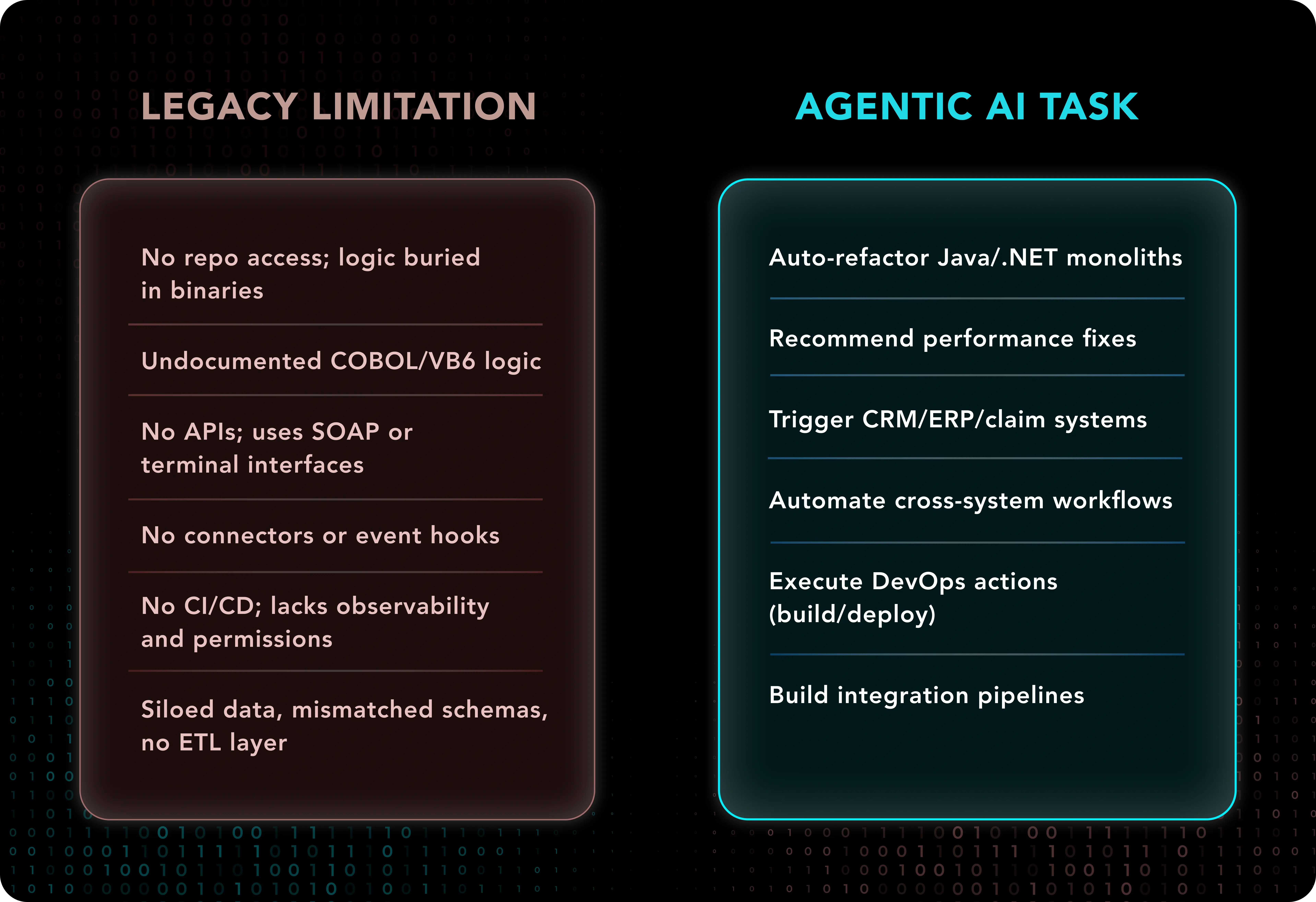
Legacy architecture is blocking Agentic AI execution, scalability and ROI. Every stalled agent is a hidden cost center draining value. Don’t let outdated systems silently kill your AI investments.
They help answer:
- Are critical CVEs buried in high-traffic code?
- Which parts of the codebase are too risky to deploy?
- Could compound logic flaws be exploited in production?
By flagging high-risk code early, teams can launch secure pilots and prevent vulnerable releases—avoiding costly rollbacks and last-minute patches.
Don’t Just Catch Up, Leap Ahead
Legacy systems silently break down and end up costing enterprises millions.
The most forward-thinking enterprises aren’t waiting for failure—they’re taking control and moving fast.
AppMod.AI is trusted by Fortune 500s and built for any enterprise ready to modernize smarter.
Modernize 4× faster, at one-third the cost—without disrupting existing operations.
Will Your Agentic AI Become Another Million-Dollar Failure?
Legacy architecture is blocking Agentic AI execution, scalability and ROI. Every stalled agent is a hidden cost center draining value. Don’t let outdated systems silently kill your AI investments.
So, how are companies responding to this silent crisis?
To stay functional, enterprises are: rehiring retired developers or paying $100–$500 per hour to freelance legacy consultants (for platforms like IBM iSeries, Oracle 10g, and .NET monoliths)
These systems are becoming digital orphans—still operational, but with no one left to support them.
The real solution is no more workforce replacement but strategic, enterprise-grade AI
Cloud-Native Architecture Migration→
Migrate from mainframe monoliths to microservices, enabling scalable systems managed by
Component-Based Code Modernization→
Rather than wrapping legacy logic in APIs, AppMod.AI fully migrates applic
Low-Code/No-Code Integration:→
Modern tools allow business users to create workflows and integrations without dee
AI-Assisted Code Translation→
Instead of wasting months onboarding engineers to untangle legacy code, AI-assisted platforms like Codebase Insights transform raw code into
Your Legacy Systems Are a Ticking Time Bomb
Your legacy tech isn’t outdated—it’s one resignation away from collapse.
👉 Book your consultation before the next failure hits.
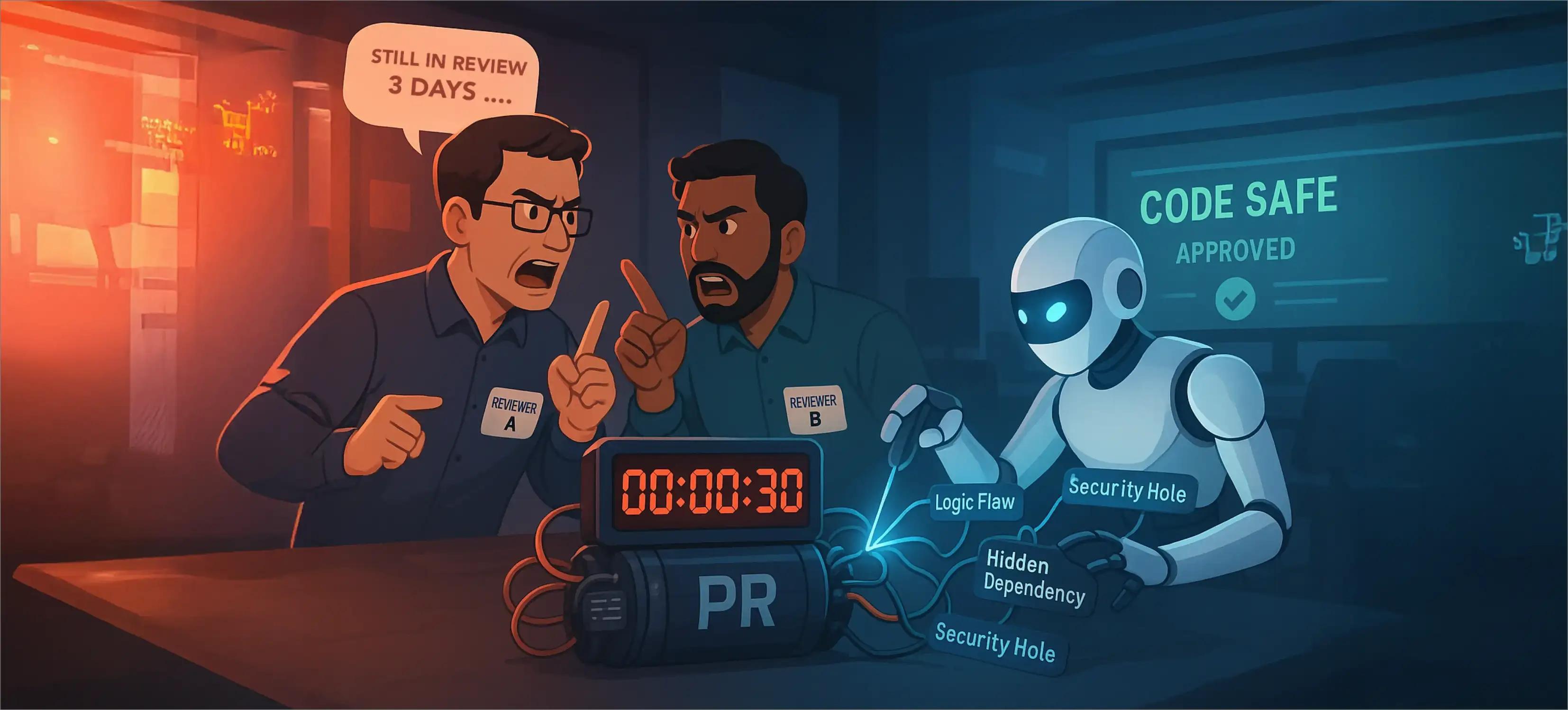
The greatest irony in modern software development is that the very process designed to prevent disasters has become the biggest obstacle to innovation – robbing businesses of their competitive advantage.
"Three days!" Tech Lead James exclaimed, pointing to Pull Request #472. "That's how long this simple feature has been sitting in review limbo!"
Just two weeks ago, a system-wide outage had nearly derailed their

Reveal Your Hidden Code Risks
See a live demo of Project Analyzer identifying vulnerabilities and cutting review cycles from days to minutes.
And the biggest shift of all? They moved from managing code to managing risk. That's the transformation Codebase Insights brought. This has a direct connection to the company’s bottom line.

“The auth deployment just broke half our services... buried dependencies we didn’t even know existed.”

The AI Gold Rush Has Begun—But Will Your Business Survive?
AI startups and enterprises must navigate the $10M dilemma or risk stagnation. Compliance hurdles, investment risks, and scaling challenges are redefining the AI industry. Gain expert insights to ensure your business not only survives but thrives in 2025.
Why Angela Joined Techolution
“I’m excited to join Techolution because I love seeing my customers’ goals go from sandbox to production—where innovation turns into real impact. Techolution is uniquely poised to accelerate this by bringing AI-driven solutions to life faster and more effectively. The company’s agility, deep expertise, and commitment to customer success make it an incredible place to drive meaningful business transformation.”
— Angela Valadez, Director, Sales, Techolution

Join Us in Welcoming Angela!
production pipeline.
Take, for example, the leading retail chain we worked with. They were struggling with inefficient inventory management and food waste. Our AI-driven demand forecasting didn’t just solve the problem—it transformed their supply chain. We reduced food waste by 70% and boosted sales 5%, turning a small pilot into a core, everyday solution.
Then, in the healthcare sector, we helped a major medical supplier scale production while maintaining compliance. By integrating AI and robotics with system engineering, FDA-compliant documentation, and 24/7 operations, we ensured continuous production without delays. The AI system provided precision defect detection with 0.01mm accuracy, enabling it to maintain the highest quality standards while meeting increased demand.

These stories show how we bridge the gap from pilot to
Customer Support : AI-driven chatbots provide personalized responses, understand customer sentiment, and improve user satisfaction. Unlike rule-based chatbots, which rely on predefined scripts, AI chatbots analyze previous conversations, making responses more relevant.

Fraud Detection : AI-powered co-pilots in banking and finance detect fraudulent transactions in real-time. Instead of relying on rigid rule-based detection, AI models analyze behavioral patterns and adapt to emerging threats.

Healthcare : AI assistants analyze patient symptoms, recommend diagnoses, and assist doctors in treatment planning. These co-pilots continuously learn from new cases, refining their diagnostic accuracy over time.

Software Development : AI-powered coding assistants, like GitHub Copilot, help developers by suggesting optimized code snippets, identifying errors, and improving efficiency. Unlike rule-based automation tools, which follow strict templates, AI co-pilots adapt to different coding styles.

Installing LazyLM
pip install lazy_lmLazyLM
from dotenv import load_dotenv
import os from anthropic
import AnthropicVertex from lazy_lm.core
import lazy

load_dotenv()
project_id = os.getenv(“PROJECT_ID”)
location = os.getenv(“PROJECT_LOCATION”)

# Initialize the Anthropic client
client = AnthropicVertex(project_id=project_id, region=location)
lazy_lm = client.lazy(“What is the derivative of `2x^3 + x^2 + 2x + 1`? Give me the solution step-by-step”)

# Get the current step
print(lazy_lm.get_current_step())
"""
What is the derivative of `2x^3 + x^2 + 2x + 1`? Give me the solution step-by-step
"""

# Get the next step
print(lazy_lm.get_next_step())
"""
To find the derivative of the given function, we’ll use the power rule and the constant rule of differentiation. Let’s start with the first term:
Step 1: Find the derivative of 2x^3 The power rule states that for a term ax^n, the derivative is nax^(n-1).
For 2x^3, we have:
  a = 2, n = 3
  So, the derivative of 2x^
"""

# Query the current step
print(lazy_lm.ask_question(“I don’t understand this step”))
"""
I apologize for any confusion. I’d be happy to explain this step in more detail without advancing to the next step.

In this step, we’re focusing on finding the derivative of the first term in the given expression, which is 2x^3.

To do this, we're using the power rule of differentiation. The power rule states that for a term in the form ax^n (where 'a' is a constant and 'n' is the power)
"""

# Get the next step
print(lazy_lm.get_next_step())
"""
Step 2: Complete the derivative of 2x^3

Continuing from the previous step, we apply the power rule to 2x^3:

The derivative of 2x^3 is:
3 · 2x^(3-1) = 3 · 2x^2 = 6x^2
"""
For example the expression:
func :: int -> int -> int
func a b = a
will always just pass back the first argument to the function
>> func (2+2) 100
4
In an eager (or strict) language like python. the evaluation of that function would look something like this
Blog Summary
Execution Gap
How Techolution Helps
Investment Gap
AI Value Finder identifies, prioritises, and builds a roadmap for the AI initiatives with the strongest business case.
Governance Gap
It delivers explainable, trustworthy AI with enterprise-grade governance and security controls.
Value Realisation Gap
This also helps organisations measure business outcomes, demonstrate ROI, and confidently scale successful AI initiatives.
Worth a read? Pass it on