On shore. Offshore → AI-shore.
AI that learns on the job instantly and, in days, surpasses human experts.



70% of Your IT Budget Is Wasted on Legacy
Legacy systems drain your spend, slow your teams, and stall innovation. Modernize with speed, security and confidence — guided by our experts.
Let me tell you about a project that almost didn't happen.
A major broadcasting company came to us with a straightforward ask: help automate their accounts payable workflow. They wanted to reduce inquiry volume and build a self-service assistant. Standard stuff. We started scoping it out.
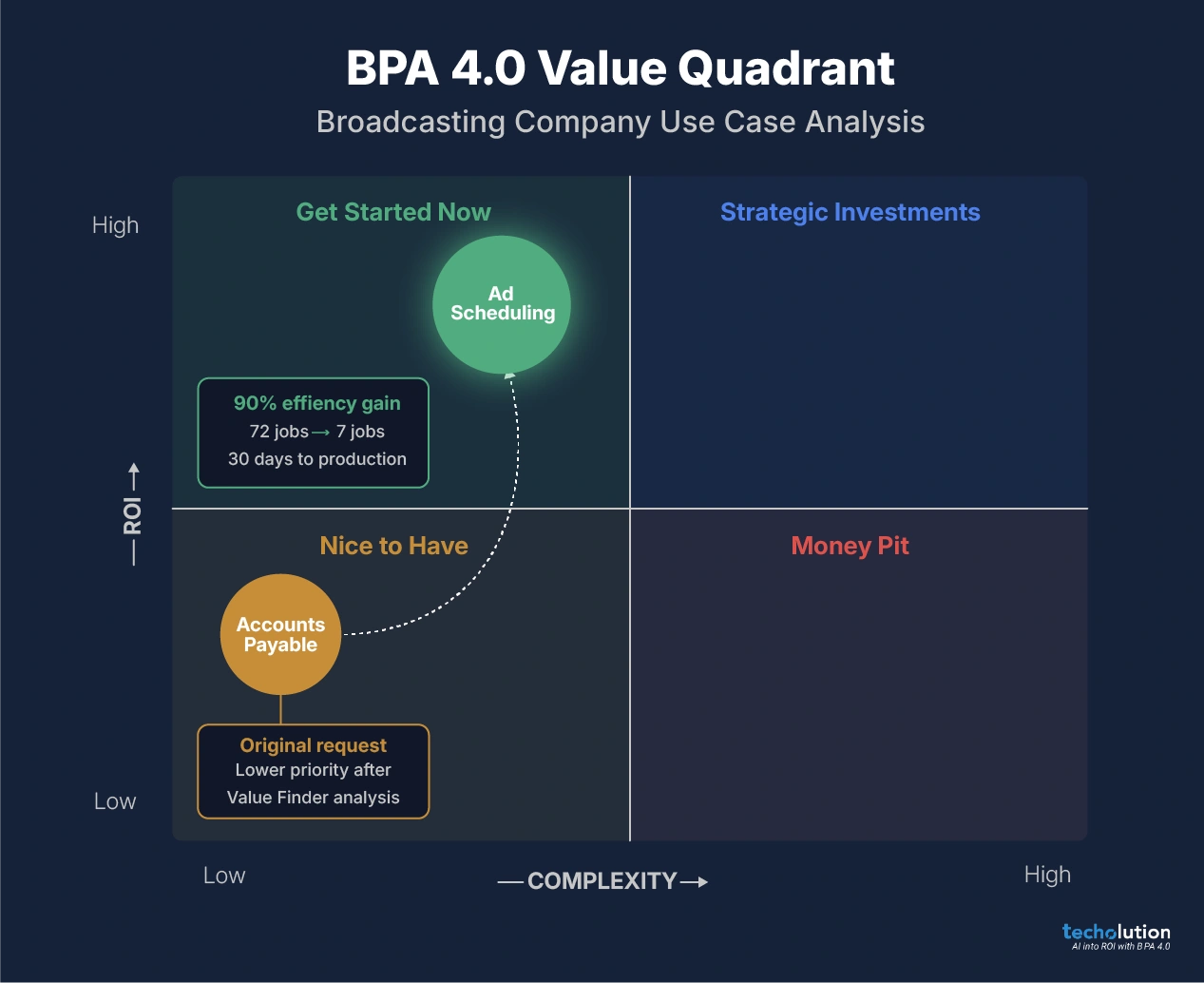
But, during our BPA 4.0 Value Finder discovery sessions, something else surfaced: a bigger problem they hadn't mentioned. They were about to offshore 72 jobs for a more critical area of their business.
Here's the backstory.
This company owns a handful of big media outlets. Every week, a few dozen people had to schedule thousands of ads across those outlets. It sounds simple until you learn the rules: legal separation requirements between competitor ads, complex timing constraints, genre-specific placement logic, advertiser preferences that change constantly. The job requires precision and expert judgment. Miss something, and you're looking at compliance violations or lost revenue.
They tried AI before, and it failed to deliver ROI. The system couldn't handle the nuance, explain its decisions, or learn from corrections. So, this company gave up on automation and started planning the offshore transition.
When our Value Finder process surfaced this use case, the numbers told a clear story. We mapped it against our Value Quadrant, plotting ROI potential against implementation complexity. Ad scheduling landed squarely in the "Get Started Now" zone: high ROI, manageable complexity, and a path to breakeven in months, not years.
What about the accounts payable work they originally asked about? Much lower priority. Ad scheduling was the obvious bigger win.
When we presented the findings, their response was basically, "Sure, go ahead. We don't expect it to work."
We rolled up our sleeves and got our hands dirty.
Thirty days later, we had a working system. We built an AI that schedules ads across 12 stations, follows all the legal and business rules, and explains every placement decision with clear citations. The traffic managers could see exactly why each ad landed where it did. When the AI made a mistake, they could correct it by chatting with it, and the system learned immediately. No need for retraining cycles or engineering tickets.
The people teaching the AI weren't developers. They were traffic managers who understood the job but didn't write code. And that was the point. As we know, expertise lives inside the minds of the people who actually do the work.
Soon, the model we built began to surpass the prowess of the human experts. Our AI actually produced fewer rule violations than the manual process. As it learned in the workflow, the violations that remained began to disappear until there were none.
With the BPA 4.0 equation, those 72 jobs became 7. They didn't get offshored. They got AI-shored. The workload moved to US data centers instead of overseas labor, which doubled the cost savings. Plus, the savings came with no exposure to tariff risk, dependency on foreign labor markets, or 12-hour timezone gaps. Operations and data stayed domestic. Cost structure was no longer predicated on trade policy stability.
The BPA 4.0 Execution Platform accelerated this value to be delivered at a previously unimaginable pace—30 days from start to finish.
One more thing. The leader on the client side who guided us through the use case rose two titles after the project launched. She's now the Chief AI Officer at that company.
That's what happens when you own an AI outcome that not only works, but generates revenue. You become the person who proved the seemingly impossible could be done.
This is what BPA 4.0 looks like when it meets a real business problem with real people. It builds a system that earns trust by showing its work.
Got a process that’s "too complex to automate"? We want to hear about it.
Worth a read? Pass it on