AI readiness for large enterprises
Is Your Enterprise Ready for AI? A Practical AI Readiness Framework for Your Organisation

10 min read

October 13, 2026



Your enterprise probably doesn't have a shortage of AI ideas. Some are already being tested. Others are waiting for funding. A few may have already shown promising results.
The harder question comes next: Which of them is your business actually ready to scale?
Because proving an AI idea works is only one part of the equation. Scaling it means the business must support it with the right data, systems, workflows, ownership, and economics.
That makes AI readiness less about asking, "Are we ready for AI?" And more about asking:
"What are we ready to scale, and what would it take to create measurable value?"
TL:DR
- AI readiness for large enterprises should be assessed around specific business opportunities.
- A working pilot doesn't automatically make an initiative ready to scale.
- Readiness depends on business value, data, systems, operations, governance, and tokenomics.
- Different AI opportunities will have different readiness requirements.
- The goal isn't to make everything AI-ready. It's to know what's worth preparing for.
What Does AI Readiness Actually Mean?
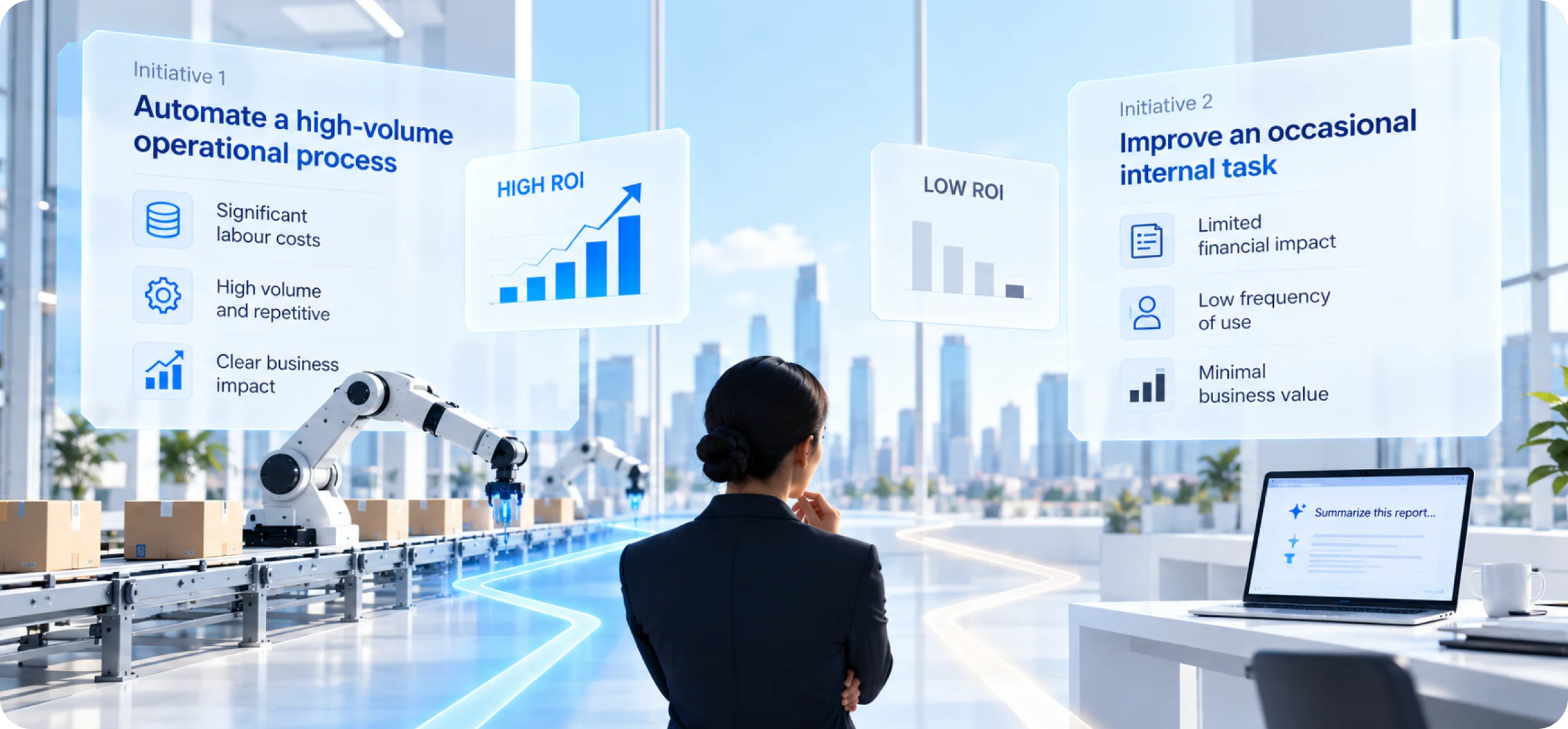
Consider two initiatives.
One could automate a high-volume operational process with significant labour costs. Another could improve an occasional internal task with limited financial impact.
Both might be technically possible. But they shouldn't receive the same investment or preparation.
AI readiness therefore starts with the business opportunity instead of the technology.
How Should Enterprises Assess AI Readiness?
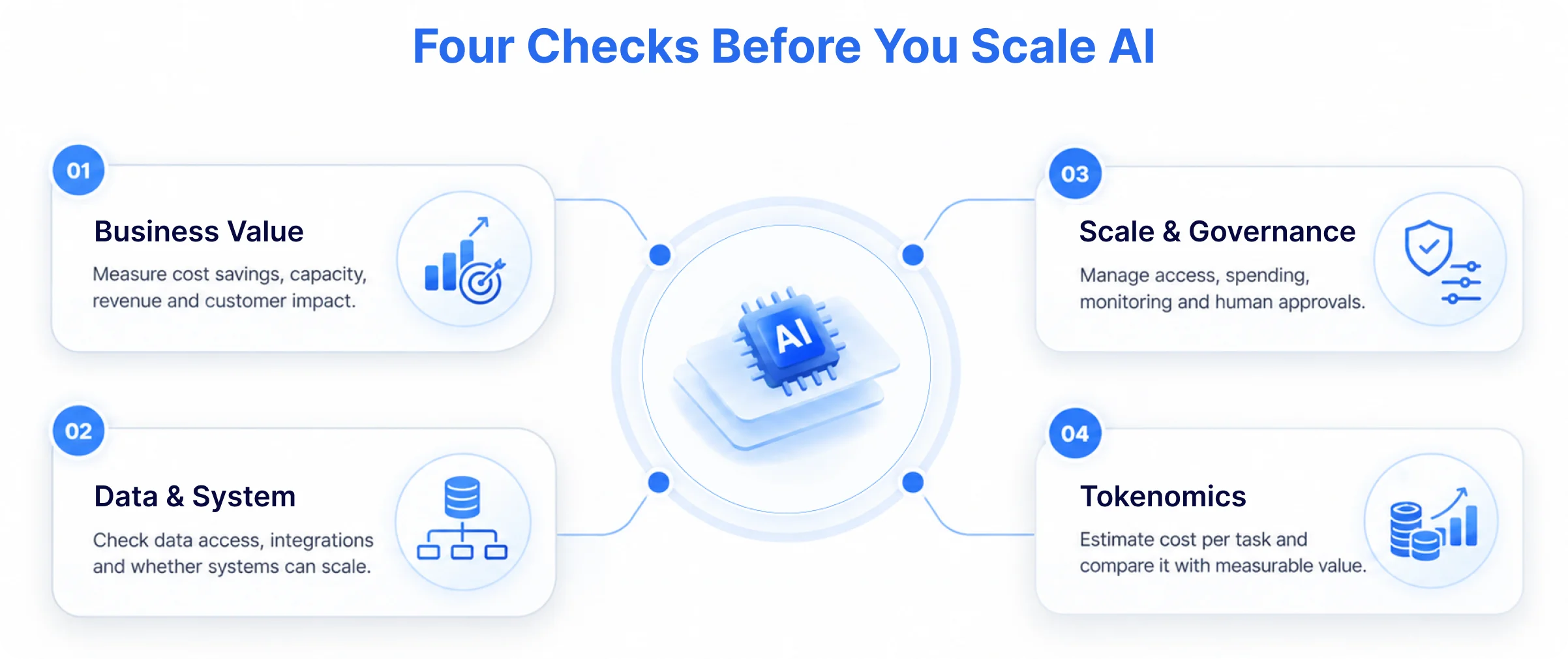
Defining the AI opportunity is only the start. Before investing, you need to understand its value, what it depends on, what it will take to scale, and where the risks are.
That's what an AI readiness assessment should make clear.
🔍
1. Business Value
First, map the AI initiatives already being tested, proposed, or funded.
Then define what each one is expected to change.
Could it reduce operating costs?→
Increase capacity?→
Accelerate a revenue-generating process?→
Reduce errors or delays?→
Improve an important customer outcome?→
A customer-service assistant, for example, shouldn't be assessed the same way as AI making financial decisions.
2. Data and System Fit
Once you know which opportunities matter, look at what stands between the pilot and wider business use.
Where does the required information live?→
Can the AI access it reliably?→
Which existing systems must it work with?→
What dependencies could make deployment difficult or expensive?→
Can it handle the number of people and tasks expected at scale?→
This is where promising initiatives often become more complicated than they appeared during experimentation. It's whether the systems and data required for this opportunity can support it.
For example, 94% of leaders recognise that well-connected data is important for AI success, yet only 27% say they have achieved it.
3. Scale and Governance
What works for a small group may behave differently across hundreds or thousands of users.
Scaling increases the need to control access, monitor spending, and investigate incidents.
AI governance makes those controls part of everyday operations. Enterprises need visibility into who uses AI, which information they can access, and when human approval is required.
Techolution’s AI Governance Platform brings oversight across models, agents, and applications into one control layer. Admins can track spending, set daily limits, and manage access by role and duration. They can also compare policy versions and review incidents with supporting evidence.

🔍
These controls help leadership assess whether an initiative can expand within approved boundaries. The oversight should match the consequences of the AI’s role. An internal productivity tool needs different controls from AI influencing financial decisions.
4. Tokenomics
Finally, readiness has to make financial sense.
AI costs extend beyond infrastructure, integration, and monthly subscriptions. Token-based pricing also charges for the information models process and generate.
Tokenomics means understanding how that token usage translates into operating costs and business value.
An automated workflow may require several AI calls to complete one task. Longer documents, repeated attempts, and growing demand can increase the cost.
Before scaling, ask:
What does each completed task cost?→
How will costs change as usage grows?→
Do savings or additional revenue justify the total operating cost?→
This turns the readiness question into an investment question:
Can this opportunity deliver measurable value at a sustainable cost?
What Are the Signs Your Enterprise Is Ready to Scale AI?
AI readiness becomes visible when growth stops creating new problems.
As usage grows, costs can rise, workflows can become harder to manage, and business value can become harder to trace. A ready enterprise can scale without letting those pressures undermine the business case.
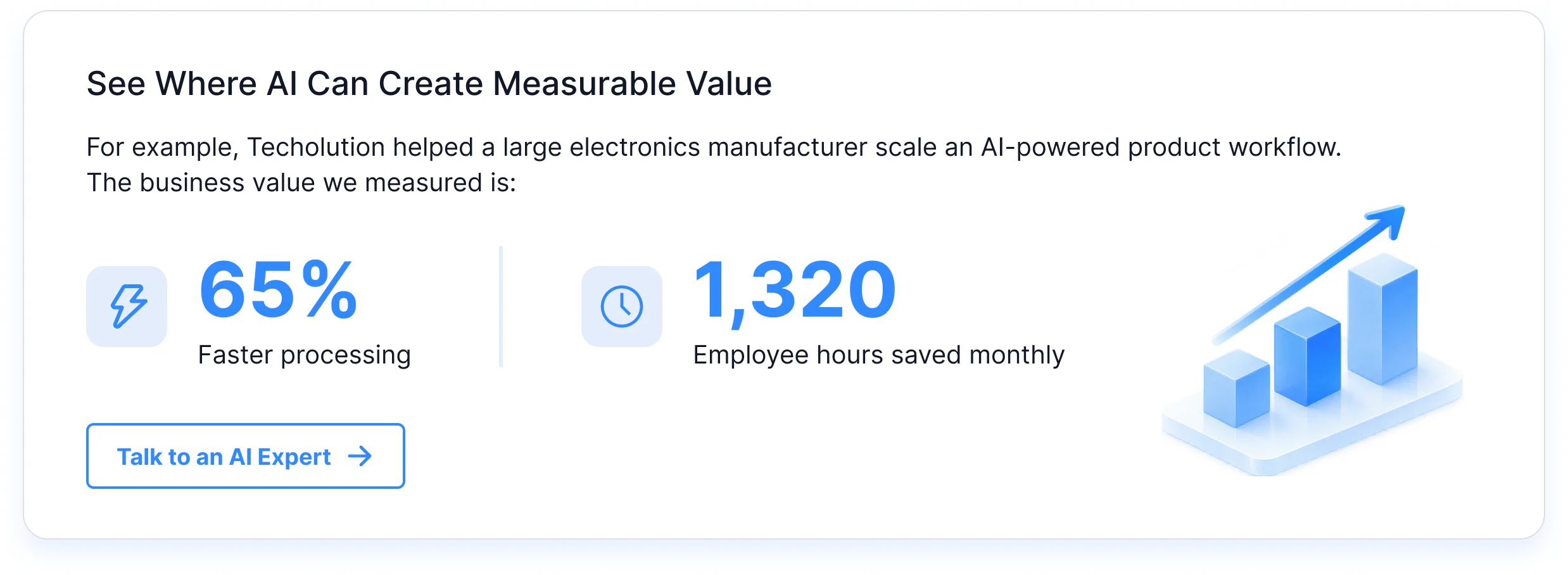
Business Impact Can Be Measured
An AI initiative can perform exactly as designed and still be a poor investment. Before scaling, leadership should be able to connect its performance to a measurable business outcome.
The question is: If we invest more in this, what improves for the business?
Scaling Becomes Repeatable
The second sign is repeatability. One successful deployment shouldn't require the organisation to rebuild everything for the next one. Processes for integration, governance, deployment, adoption, and measurement should become easier to reuse.
As that foundation improves, the effort required to move from one valuable opportunity to the next should decrease.
You Know What Not to Scale
Perhaps the strongest sign of AI readiness for large enterprises is knowing when to say no. Not every successful pilot deserves a larger budget. An AI initiative may work but create too little value. Another may offer significant value but require too much investment today.
A third may be both valuable and ready to move. So, you must know which ones are NOT worth getting ready for.
What Should You Do Before Funding Your Next AI Initiative?
Readiness tells you whether an AI opportunity can scale. ROI tells you whether it should.
Techolution's AI Value Finder brings both into one decision. In three days, it evaluates each opportunity against expected value, readiness, effort, risk, and potential ROI. The outcome is a prioritised AI roadmap built for one decision: where should your next AI dollar go?
Know what's worth funding before you fund it.

Worth a read? Pass it on